
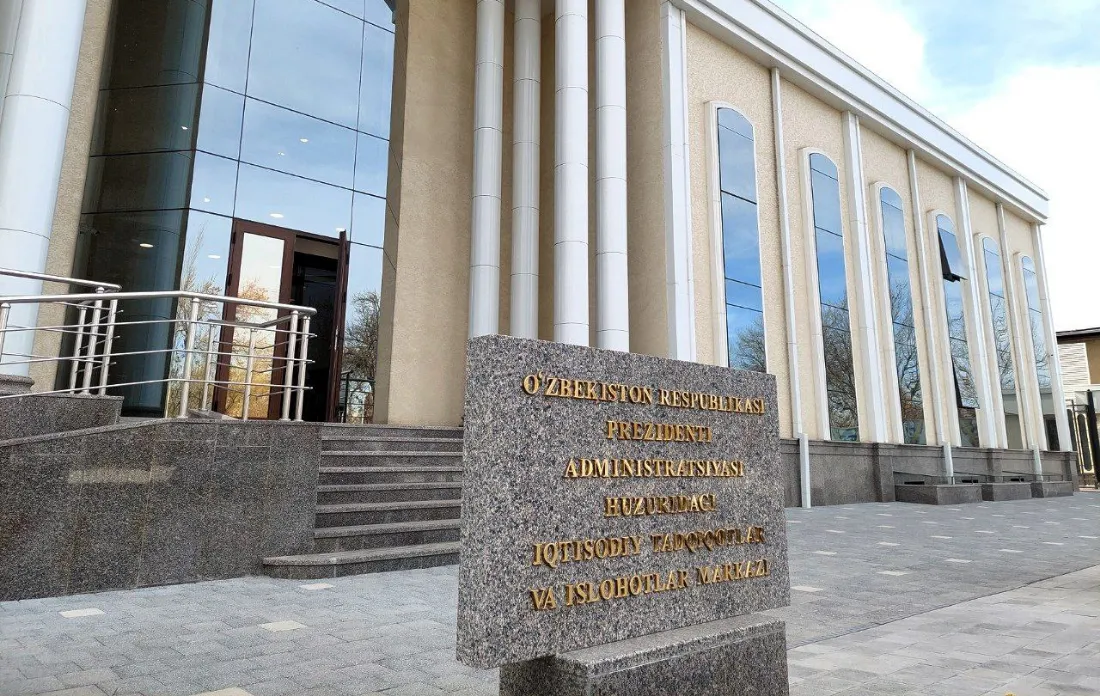
Initially, the Center for Economic Research was established in April 1999 on the basis of the Order of the President of the Republic of Uzbekistan "On the Establishment of the Center for Economic Research". The Center was founded on the initiative of UNDP, the World Bank and the German Agency for Technical Cooperation (GTZ) on the foundation of the UNDP project on macroeconomic analysis and personnel training. In addition to UNDP, the Center actively participated in joint projects and initiatives with international technical assistance organisations such as the World Bank, ADB, USAID, JICA, DFID and the Eurasia Foundation.
History before the transformation
The initial scope of tasks set for the CER in 1999 was very broad: studying the process of economic reforms in Uzbekistan, developing proposals for further liberalisation of the economy, developing and introducing modern methods of macroeconomic analysis and forecasting, and informing the international community about the economic reforms under way in the country. Many of the Center's outputs contributed to the preparation of state development programmes and regulatory documents.
One of the Center's important tasks was training qualified economists, which was also the goal of the UNDP project. Over the years, many young economists and journalists writing on economic topics worked at the Center and its journal, and numerous national experts participated in its research. After this mission was accomplished, the UNDP project was completed in 2016.
The Center published information and analytical reviews and reports, digests of economic publications from the foreign press, annual reports on Uzbekistan's economic development and human development, the statistical compilation "Uzbekistan Almanac", and the information and analytical bulletin "Economy of Uzbekistan". Since 2015, the "Business Activity Index" has been published monthly, and since June of the current year, the "Regional Business Activity Index". However, the Center's flagship publication is the "Economic Review" journal, published since 1999 within the UNDP project and remaining Uzbekistan's leading analytical publication for 20 years.
The CER has also gained international recognition. Since 2007, the Center has been included in the most authoritative annual ranking, the "Global Go To Think Tank Index Report" of the University of Pennsylvania (USA). In 2012, the CER joined the top 20 think tanks in Asia and has been strengthening its position ever since. Following 2016 results, the Center ranked 13th among Central Asian think tanks, 12th in 2017, and 11th in the "Central Asia and Caucasus region" category in 2018. In addition, in 2018 the CER became one of the founders of the consortium of economic analytical centres of the Shanghai Cooperation Organisation.
Transformation
More than twenty years have passed since the establishment of the Center for Economic Research. At the time of its creation, the country was transitioning from a planned economy to a market economy, and state institutions for managing the economy under market conditions were just taking shape. Many changes have occurred in the country's socio-economic development over the years. A large human resource potential was built in the field of economic governance. The private sector has taken an important place in the economy.
Since 2017, a new period of reforms began in Uzbekistan, characterised by deep and comprehensive transformations in all spheres of state life and activity. The President of the Republic of Uzbekistan approved the Strategy of Actions on five priority directions of the country's development for 2017–2021.
New tasks were set in the economic sphere to increase competitiveness, diversify and digitalise the economy. In the social sphere, Uzbekistan is moving into the group of middle-income countries. The range of economic tasks and social directions has expanded significantly. In-depth analytical elaboration of these tasks required expanding the Center's activities and strengthening its resource potential.
In order to improve the quality of initiatives to reform the socio-economic sphere, the effectiveness of the reforms being implemented, to orient research towards the priority directions of reforms and to enhance the Center's role in developing and implementing socio-economic policy measures, Resolution No. PP-4471 of the President of the Republic of Uzbekistan "On measures to improve the quality and role of economic research in socio-economic development" was adopted on 3 October 2019 (lex.uz).
In accordance with this resolution, the Center for Economic Research was transformed into the Center for Economic Research and Reforms (CERR) under the Administration of the President of the Republic of Uzbekistan.
New directions
In addition to a significant expansion of its core activities, the Center was also assigned coordinating functions in a number of areas.
CERR was tasked with establishing an open innovation platform based on the "OPEN SPACE" principle for effective intersectoral and interagency cooperation between government bodies and organisations, analytical and scientific centres, local executive authorities, business entities, civil society representatives, the expert community and other stakeholders. Within this platform, a dedicated internet portal will be launched, providing opportunities for dialogue between government bodies, the public and the scientific community, conducting sociological surveys, introducing "feedback" mechanisms between the state and society, and discussing economic and social problems.
Identifying the most pressing problems of the current economic policy, mobilising resources and focusing attention on them is of key importance. To organise this process, the establishment of a Socio-Economic Reforms Accelerator under the Presidential Administration and a working body of this Accelerator within the Center's structure is envisaged. The main purpose of this structure is the rapid and effective mobilisation of resources of government bodies and organisations to solve pressing problems of socio-economic development.
Based on the experience of the Government Accelerator of the United Arab Emirates, a CERR delegation visited the UAE on 3–8 November 2019. CERR staff participated in the "Government Accelerators Training Workshop".
Within the framework of the Accelerator's activities, a list of problems requiring intersectoral and interagency solutions is compiled quarterly. This list is formed on the basis of monitoring the implementation of socio-economic reforms, CERR research, proposals from ministries and agencies, media and social media materials. In agreement with the divisions of the Presidential Administration, these problems are published in the media and on the CERR official website.
In addition, CERR was tasked with organising the activities of the International Experts Group under the Economic Council to ensure the implementation of the "roadmap" of the main directions of structural reforms in the Republic of Uzbekistan for 2019–2021.
The Center's media activity deserves special attention. Through this activity, the results of research are communicated to a wide audience, and topical issues are openly discussed in the media. The Center continues to publish its flagship publication, the "Economic Review" journal, on a monthly basis, featuring articles by specialists in the economic and social spheres. Last year, the journal celebrated its 20th anniversary. The electronic version, the REVIEW.UZ website, has expanded its range of analytical publications. Scientific articles and commentaries by the Center's staff are regularly published in domestic and foreign media. The Center's management and staff participate in press club programmes and provide analytical assessments in print and electronic media.
Regional branches of the Center for Economic Research and Reforms
Another important event in the history of CERR, regarded as one of Uzbekistan's leading think tanks, was the opening of regional branches in the Republic of Karakalpakstan and the Jizzakh, Namangan, Samarkand and Kashkadarya regions.
In accordance with Resolution No. PP-5223 of the President of the Republic of Uzbekistan of 13 August 2021 "On additional measures to improve the quality and role of economic research in socio-economic development" (lex.uz), additional tasks were assigned to CERR.
This resolution was adopted to ensure the effectiveness of reforms under way in the country and to develop, on the basis of science-based innovative approaches, development programmes for regions, industries and spheres for 2022–2026.
Within the framework of the additional tasks, regular provision of local government bodies with science-based proposals and recommendations is envisaged.
The Center's research will be aimed at preparing proposals for creating new production chains in economic sectors based on studying the existing resource base.
Together with the Council of Ministers of the Republic of Karakalpakstan and the hokimiyats of regions and the city of Tashkent, quarterly surveys of the population at district level will be conducted.
The Center will continue studying the impact of Uzbekistan's integration into the world economy on the national economy and will submit science-based proposals and recommendations to the relevant government bodies.
CERR develops science-based proposals for authorised bodies based on an in-depth analysis of advanced international experience in developing industrial clusters.
A new stage of qualitative development
Today the Center's activities are positively assessed both domestically and internationally. In particular, in 2020 CERR joined the top 10 "think tanks" in Central Asia and the Caucasus, rising three positions from 13th place in 2016.
In conclusion, it should be noted that the modern world is entering the digital age. This is a serious challenge for countries that are not sufficiently prepared technologically and economically. Global economic competition is intensifying. In such conditions, the economic competitiveness of countries is becoming a decisive factor for successful development. This depends not only on resources but also on economic policy and strategy — strengthening existing advantages, raising labour productivity and advancing the economy to high-tech levels, which enables the creation of high added value in the international division of labour.
Deeply analysing current economic decisions from the standpoint of developing precisely such a policy, deepening reforms and withstanding the economic challenges of a changing world is a great responsibility and a challenge facing economic analysts and think tanks, in particular the Center for Economic Research and Reforms.